30 October 2012

We are the sole survivors of a world no one else has ever seen


            I finished reading Colum McCann's "Let the Great World Spin". I came away thinking it was masterful. Colum is one of us New Yorkers; he captures the city from within the heart of the town, not as an outside observation (ick). In this piece for The New York Times, McCann writes of the dog days of baseball in New York, expressing a very spiritual sentiment for such an Earth-based game.
          To finish a book such as this is to end a poetic journey that makes you want to linger over the last dozen pages longer. You identify with the spirit of the book, with the character, and you wish you could be pals with the author (a la "The Catcher in the Rye") because they are the only connection to this world of which no one else has ever seen. I might mention that moment when you finish a book, look around, and realize everyone is just carrying on with their lives as though you didn't just experience emotional trauma at the hands of a paperback. 
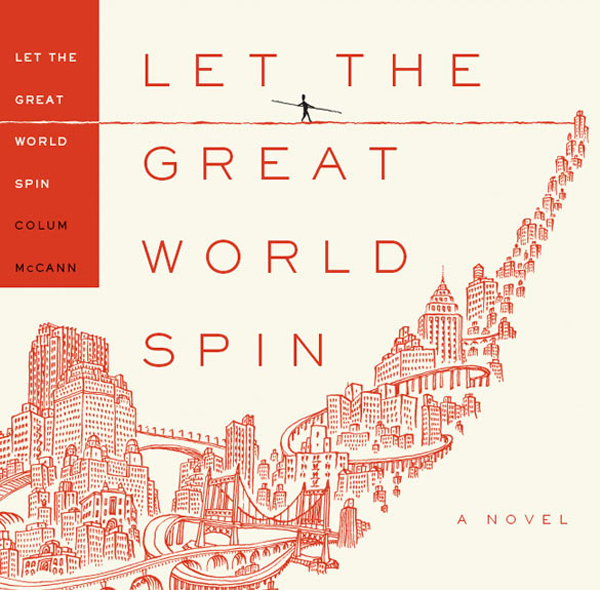
Random House, published 2009
          "Let the Great World Spin" belongs to the newly forming genre of post-9/11 arts, literature, and music. Post-9/11 is a largely retrospective genre. I would define it as an art made as a reaction to or influenced by the events of September 11, directly or indirectly. The films "Extremely Loud and Incredibly Close", "The Hurt Locker", and to an extent (one of my favorites with George Clooney) "Up in the Air", as well as the books "Three Cups of Tea" and "Someday this Pain Will Be Useful to You", and several pieces by the American composer Rene Clausen are all considered a part of post-9/11 art. So is the children's book and Caldecott Award recipient "The Man Who Walked Between the Towers", which in fact is related to McCann's novel. It is quite amazing to see this timely thematic genre form within the dawn of my lifetime.
          The arts created in response to September 11 I perceive to be usually unafraid to reveal the brokenness of the world. We have become distrustful of each other on the outside as we line up at airport security checks, walk past each other in the city at night, or wear apparel of cultural nature, be it the hijab or a chained cross.  But within ourselves we know we want to trust our neighbor, we want to embrace anyone else who seeks peace.  

20 October 2012

On a church spire

"When I look up at the spire, do you know what I see? This is my interpretation: 
The great Adventist Christian posture, my friends, is not kneeling, sitting, or standing. It's looking up.  
And when I look up at that spire, when I walk in front of this church, and I look through it to the very clouds, the skies, and the heavens - I look up to the place where I look forward to the coming of Jesus."
Alex Bryan

28 September 2012

Another Article: Bill Gates on life and death

Bill Gates wrote a letter to Steve Jobs, who kept it by his bedside as he lay dying. In this profile by Mary Riddell of The Daily Telegraph, Gates addresses economic fairness, philanthropy, his friendship with business rival Jobs, and what will become of himself and his legacy.
Though not especially religious, and far from pious (“People on the front line are the saints”), Bill Gates is driven on by faith. “I believed in the personal computer and I devoted my life to it,” he says. “If you have a dream, and it comes true, it’s a very cool thing.” Now he extends the passion he once expended on enterprise to ending disease and starvation. The man who changed the way the rich world lives is equally determined to change the way in which the poor world dies.
Source.

13 September 2012

On God and our political platforms

"There seems to be a misconception among many American Christians that fighting the good fight of faith means keeping God’s name on our money, in our speeches, in our pledge, and on our bumper stickers.
But this is the danger of civic religion: it convinces us that God’s name is the same as God’s presence; it convinces us that we’ve “won” when we hear the right words, regardless of whether we’ve seen the right fruit. But God’s name is not enough, and America has a troubled history of slavery, ethnic cleansing, and the destruction of creation to show that invoking God’s name is not the same as earning God’s favor.
As Susan B. Anthony so wisely put it, “I distrust those people who know so well what God wants them to do because I notice it always coincides with their own desires.” Ironically, we render God’s name more meaningless each time we use it carelessly to advance our own agendas."
Rachel Held Evans

07 September 2012

The kingdom of God is near


           Of course a number of issues bother young people today, among them sex, relationships, academic and career options, etc. So for anyone of us with a faith background, we deal with the relevance of faith in our lives, as well as one other question that becomes pertinent with maturity into adulthood: What is the will of God in my life?